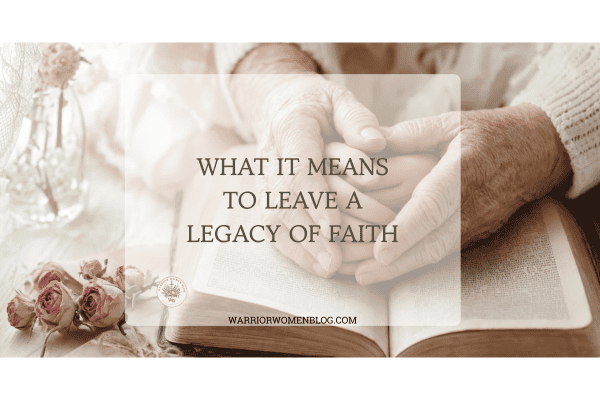
What It Means to Leave a Legacy of Faith
After 21 years working in hospice care, I’ve sat in a lot of rooms at the end of a lot of lives. If you have ever wondered, what is a legacy of faith and how do I leave one for my family, I’ve learned that you don’t have to wait until your final days to start building it.

Articles may contain affiliate links. As an Amazon Associate I earn a small commission from qualifying purchases. View scripture reference copyright FAQ
What I hear — over and over — is some version of, “I hope they remember I loved Jesus.” That’s a legacy of faith. And the good news is, you don’t have to wait until your final days to start building one. You don’t have to be a perfect theologian or have a flawless past. You just need to be intentional today.
What is a Legacy of Faith?
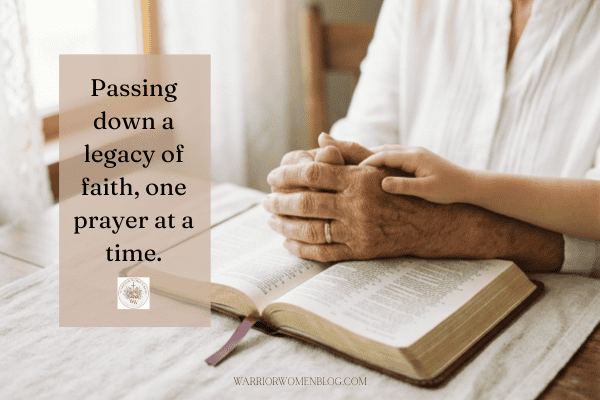
A legacy of faith isn’t a will or a financial inheritance — it’s what your children and grandchildren carry with them about who God is, because of who they watched you be. Paul described this beautifully when he told Timothy:
“I remember your genuine faith, for you share the faith that first lived in your grandmother Lois and your mother Eunice and now lives in you.” — 2 Timothy 1:5 (NLT)
Lois never knew her daily, quiet faith would still be quoted in Holy Scripture thousands of years later. She didn’t have a mega-ministry; she just lived her faith out loud, in front of the people she loved most. That is our assignment.
Why You Don’t Have to Wait Until You’re Gone
We tend to think of “legacy” as something passive that happens after we’re gone — a letter someone finds in a dusty drawer, or a sweet memory shared at a funeral. But Scripture talks about it as something active, happening right now, directly at your kitchen table:
“Repeat them again and again to your children. Talk about them when you are at home and when you are on the road, when you are going to bed and when you are getting up.” — Deuteronomy 6:7 (NLT)
A legacy of faith is built on ordinary, messy Tuesdays, not just in dramatic, picture-perfect moments. That means you can start today, exactly where you are.
5 Simple Ways to Start Building Your Legacy Today
1. Pray Scripture over them by name.
Don’t just pray for your children and grandchildren—pray specific verses over them out loud using their names. When they hear your voice bringing their specific name before the throne of God, it leaves an indelible mark on their hearts.
- Try this tonight: Open your Bible to Joshua 1:9 and pray: “Lord, I pray that [Name] will be strong and courageous. Do not let them be afraid or discouraged, for you are with them wherever they go.” Specific, word-of-God prayers are the ones that stick.
2. Tell your story — especially the hard parts.
Your grandchildren don’t need a perfectly polished, flawless testimony; they need to know about the real moments God showed up in your life. Share how He met you in your marriage, your health, your finances, or your deepest grief.
- The Reality: Simply telling them “God is good” sounds like a slogan. Telling them, “Here is the exact week the pantry was empty, and God provided a check in the mail out of nowhere,” is a legacy. Let them see how your faith survived the storms.
3. Write it down.
Spoken words can fade from memory, but a written letter stands the test of time. You don’t need to write a book; just buy a simple notebook and start writing letters to them. For more practical inspiration on how to pass down your faith, be sure to read my guide on 7 Valuable Ways Mothers Leave a Legacy of Faith to find more ways to connect with your kids.
- What to write: Journal the prayers you’ve whispered for them in the middle of the night, the verses that carried you through your darkest seasons, and the life lessons you want them to hold onto. One day, long after you are gone, that notebook will be far more valuable to them than gold.
4. Model faith on ordinary days, not just Sundays.
Our families are watching how we handle heavy traffic, a difficult medical diagnosis, a rude customer, or a sudden disappointment far more than they are watching what we do in a church pew.
- The Daily Walk: Consistency in the quiet, frustrating moments teaches biblical truth more powerfully than a single big sermon ever will. Let them see you run to prayer when you’re stressed, rather than running to anger.
5. Invite them into the faith, don’t just expose them to it.
There is a massive difference between a child who watches you pray from across the room and a child who prays with you.
- Take Action: Next time a grandchild mentions they are nervous about a test or a friend at school, don’t just say, “I’ll pray for you.” Stop right there, grab their hand, and say, “Let’s talk to Jesus about that together right now.” Faith that is actively participated in always goes deeper than faith that is only observed.

The Beautiful Truth About Legacy
The enemy loves to whisper to mothers and grandmothers that it’s too late, or that past mistakes have ruined our chances of leaving a godly inheritance. But grace says otherwise.
Your legacy isn’t about being perfect; it’s about pointing to a Savior who is. You don’t need decades left on the clock to build something lasting. You just need today and a willingness to start.
Which of these five steps are you going to start with this week? Let me know in the comments below so I can stand in agreement and pray over your family’s legacy journey! You can also send me a personal message directly through my Contact Page anytime.”
Be blessed in the battle,
Karen
What does it mean to leave a spiritual legacy?
A spiritual legacy is the faith, values, and example you pass down to the next generation — not
through money or possessions, but through how you lived, prayed, and pointed them toward
God.
How can I start leaving a legacy of faith if my kids are already grown?
It’s not too late. Write the letter you wish someone had written you, start praying Scripture over
your adult children and grandchildren by name, and look for natural moments to share your story
— a phone call, a holiday gathering, a text message.
Is it too late to start?
No. Psalm 78:4 says we will tell the next generation about the Lord’s faithfulness — present
tense, ongoing. Every season of life still has “next generation” moments ahead of it.
What’s the difference between leaving a legacy and just being a good example?
A good example is passive — people notice it. A legacy is active — you intentionally pass it on
through prayer, story, and invitation, rather than hoping it’s absorbed by osmosis.
You don’t need a perfect testimony or decades left to build something lasting. You need today,
and a willingness to start. Pick one of the five steps above and do it this week.
Be blessed in the battle,
Karen